
Hosted by: SIAM, TXST Department of Mathematics and the San Marcos Public Library
Location: San Marcos Public Library
Date: Saturday, April 25th, 2026
Time: Noon to 4 PM
decorative image
Julia Robinson Math Festival
Student Focused
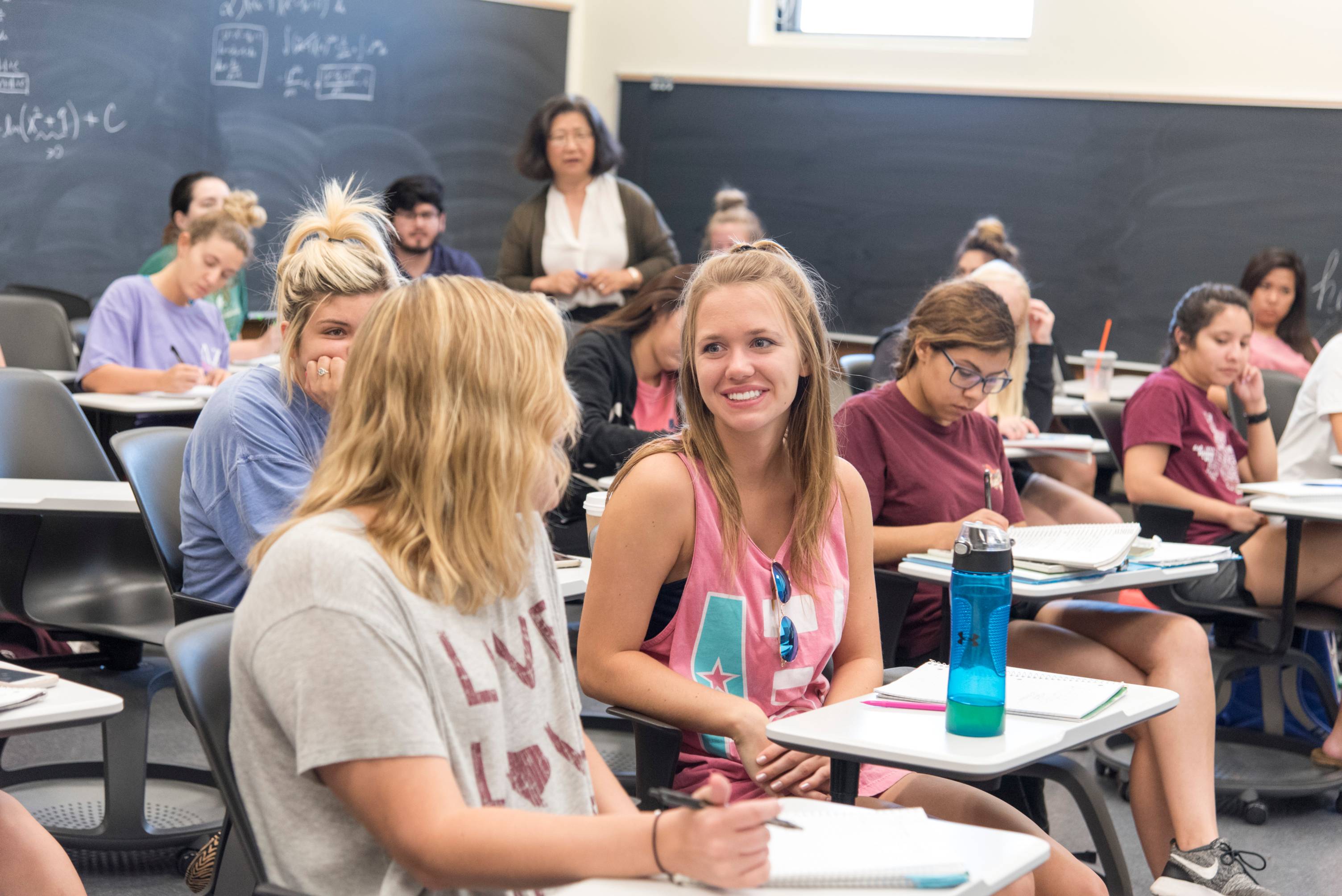
We have a wide offering of general education courses designed to prepare you to major in Business and STEM (Science, Technology, Engineering, and Mathematics) fields.
In Active Grants
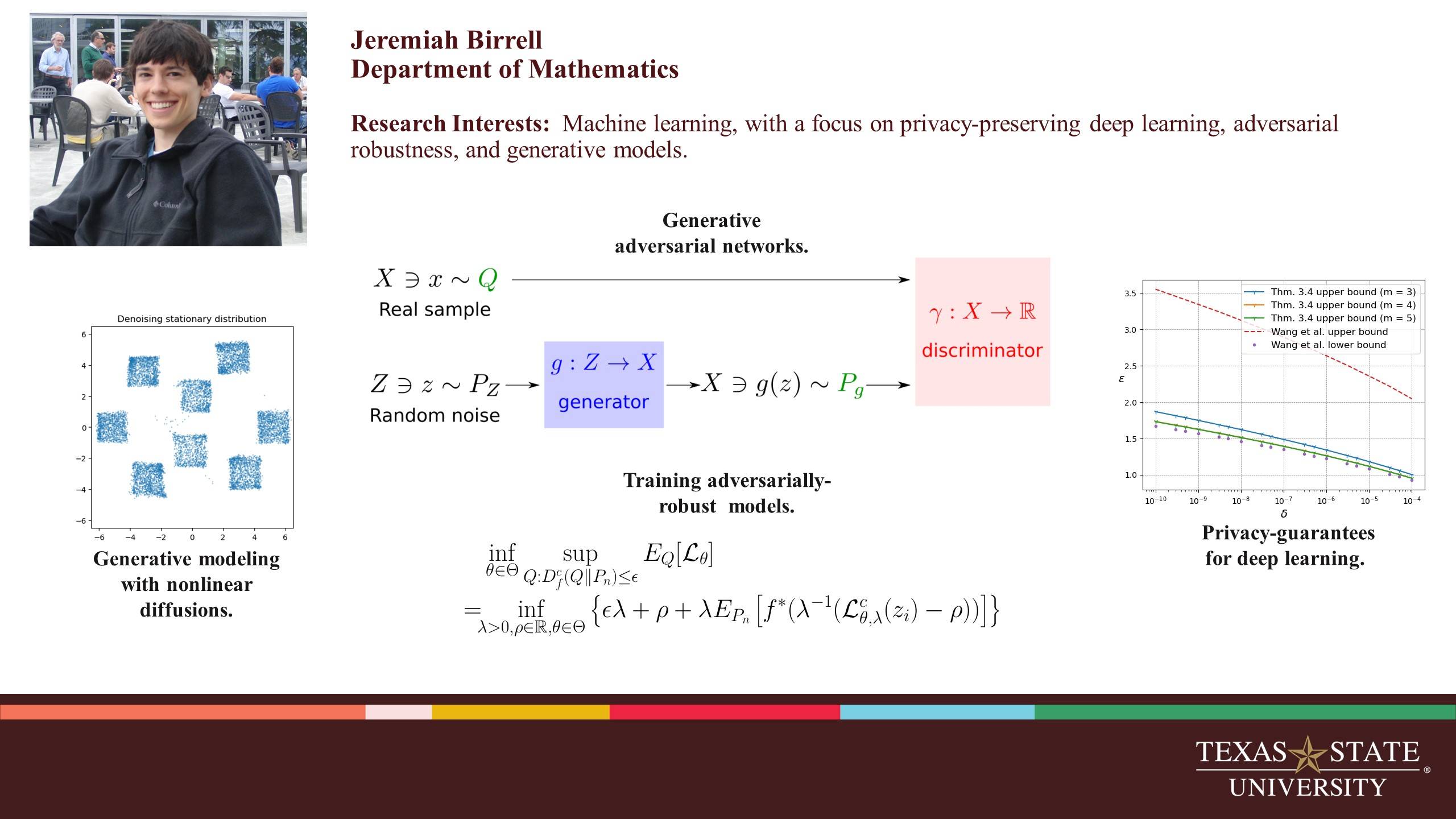
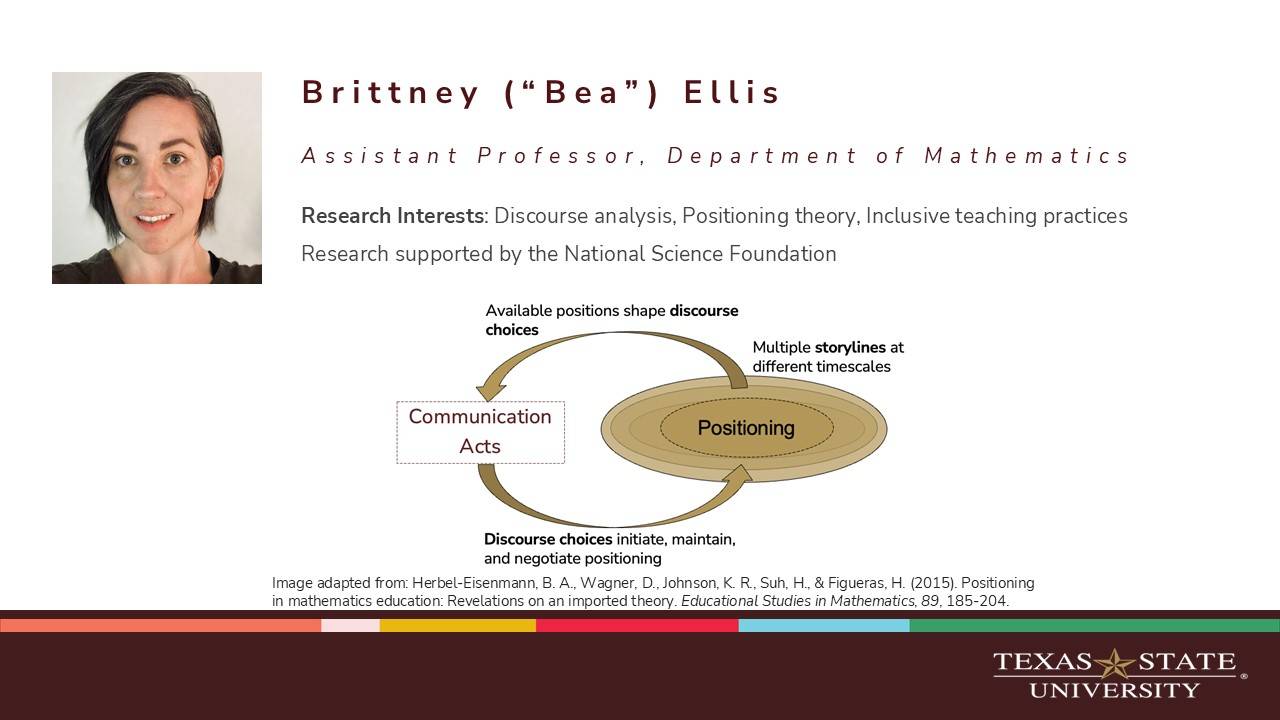
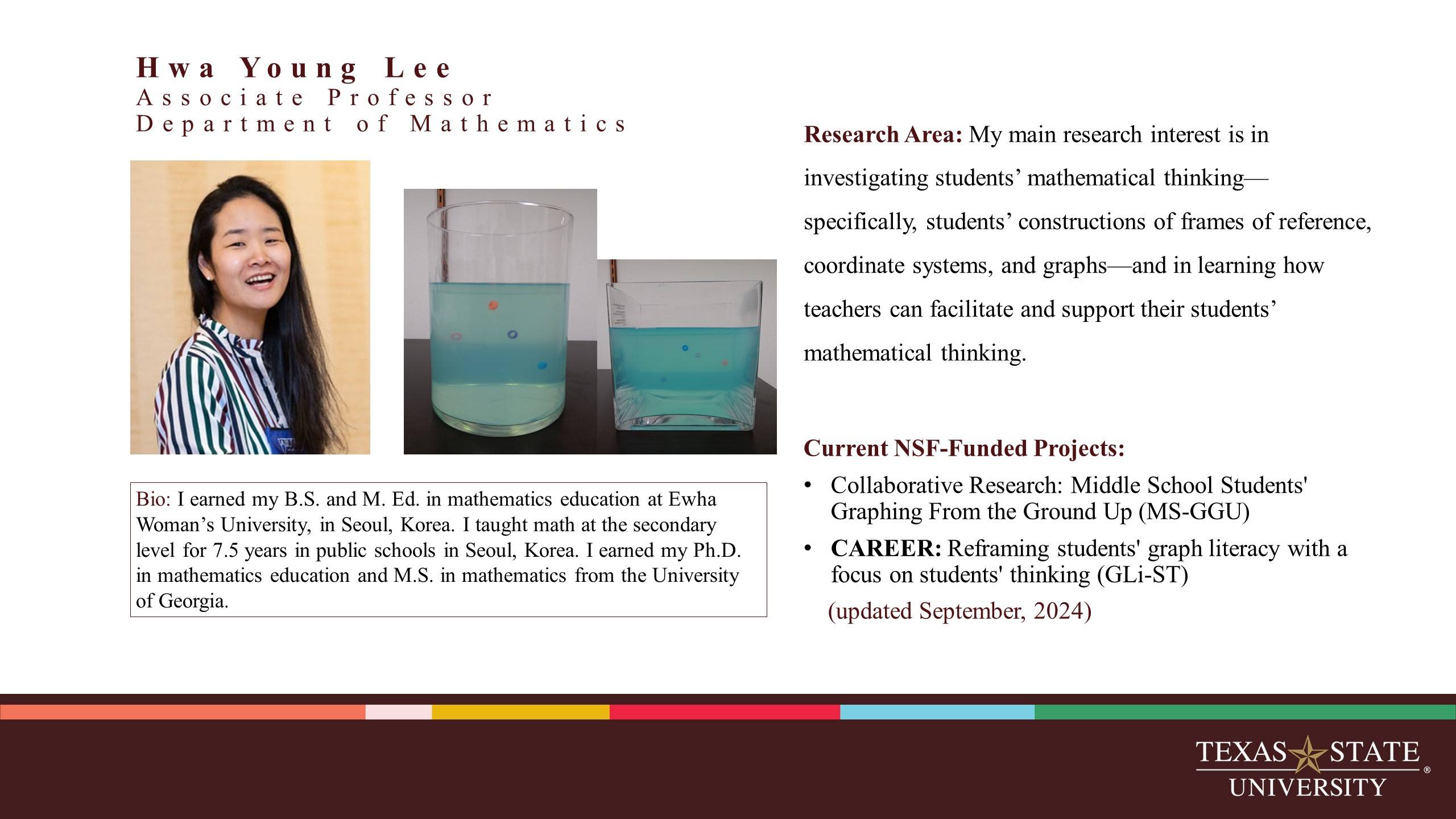
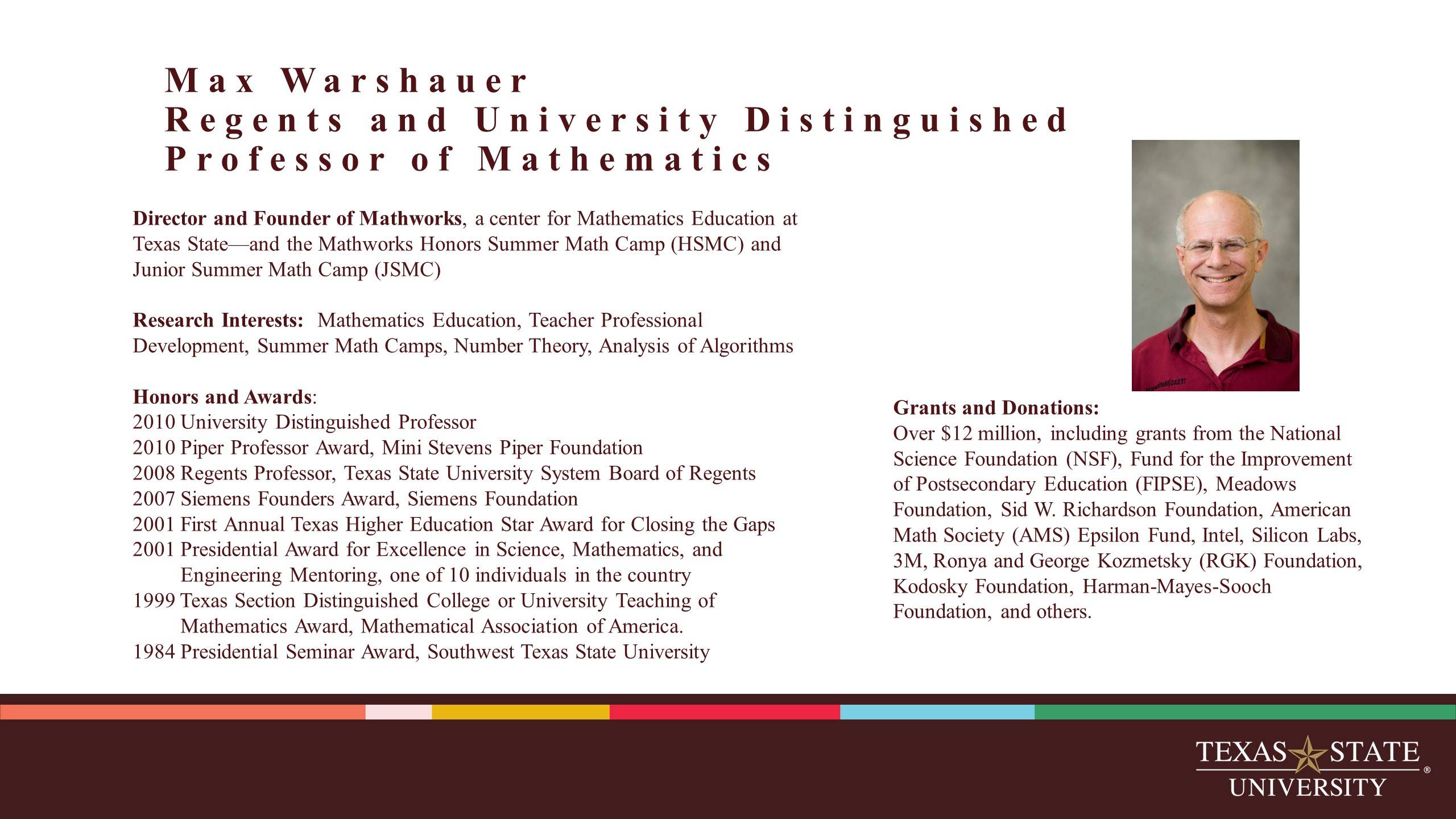
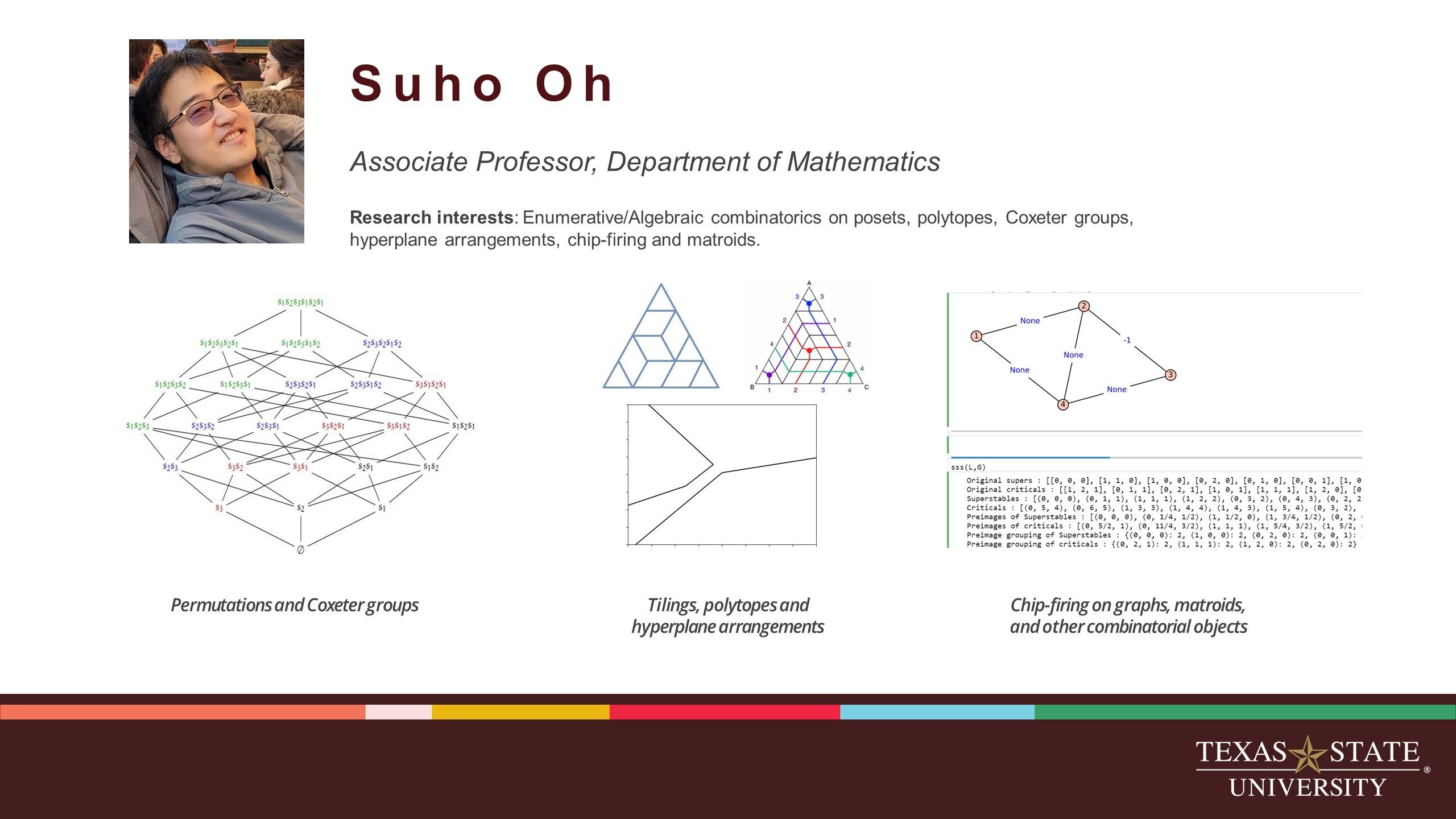
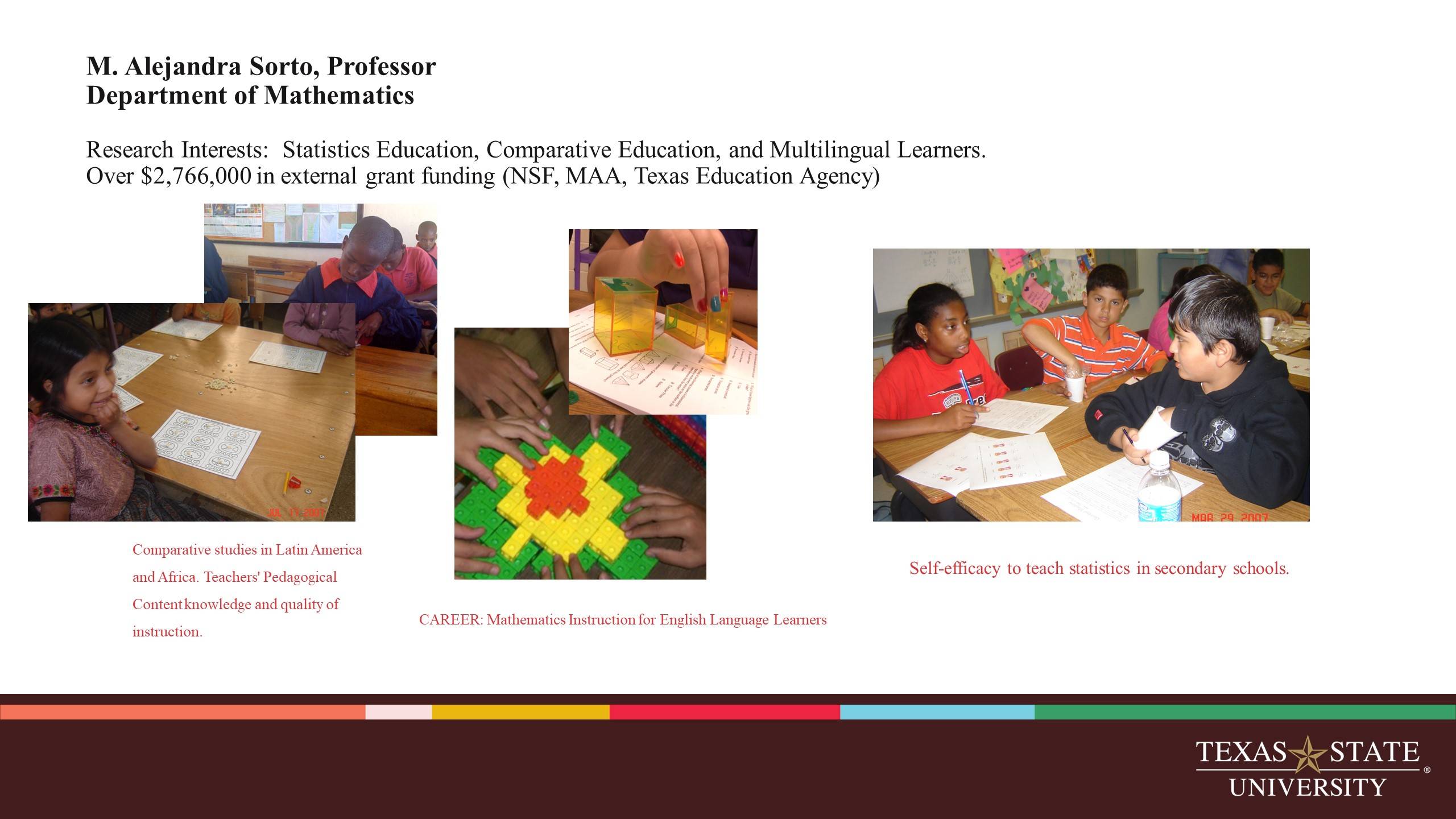
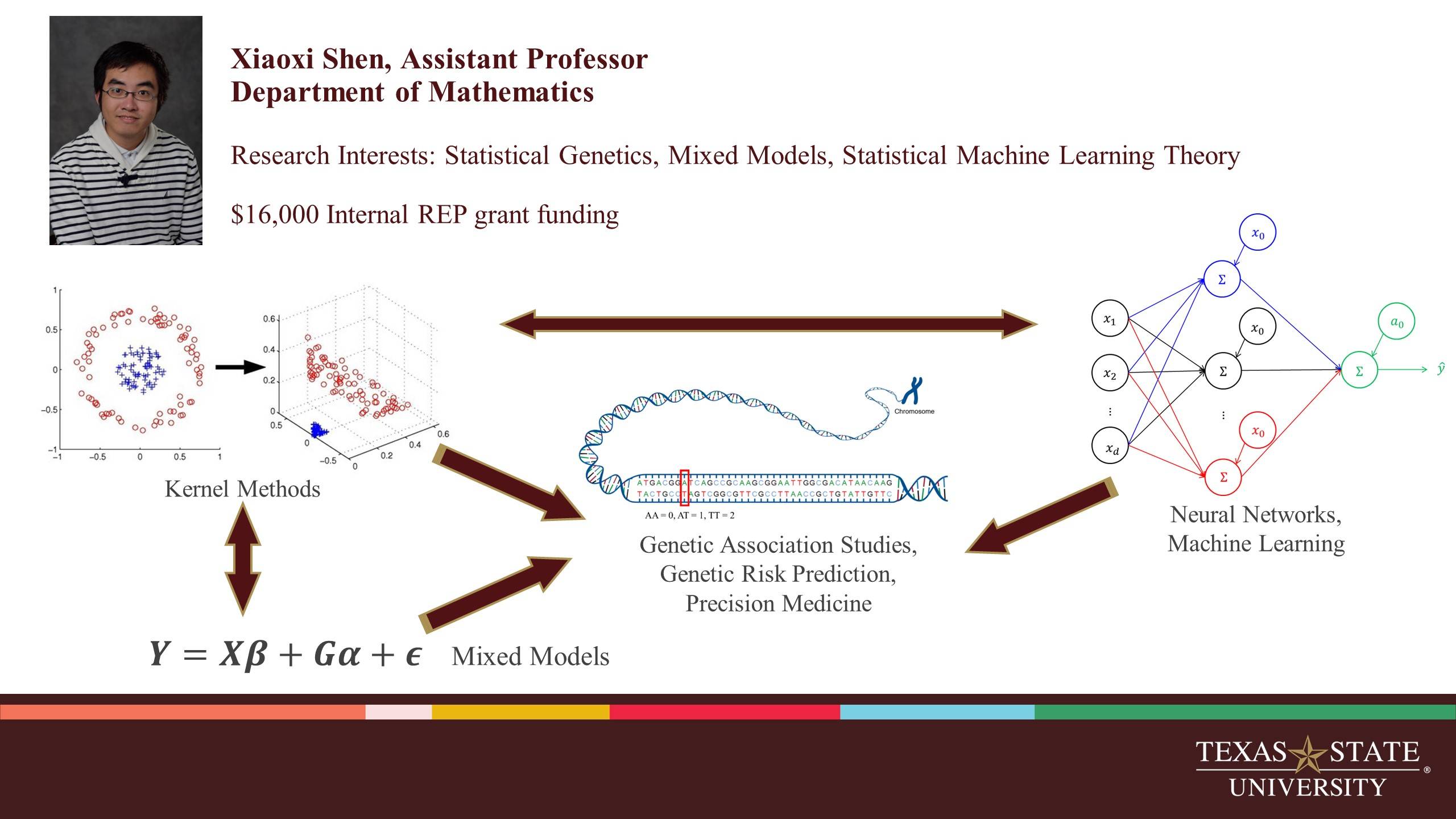
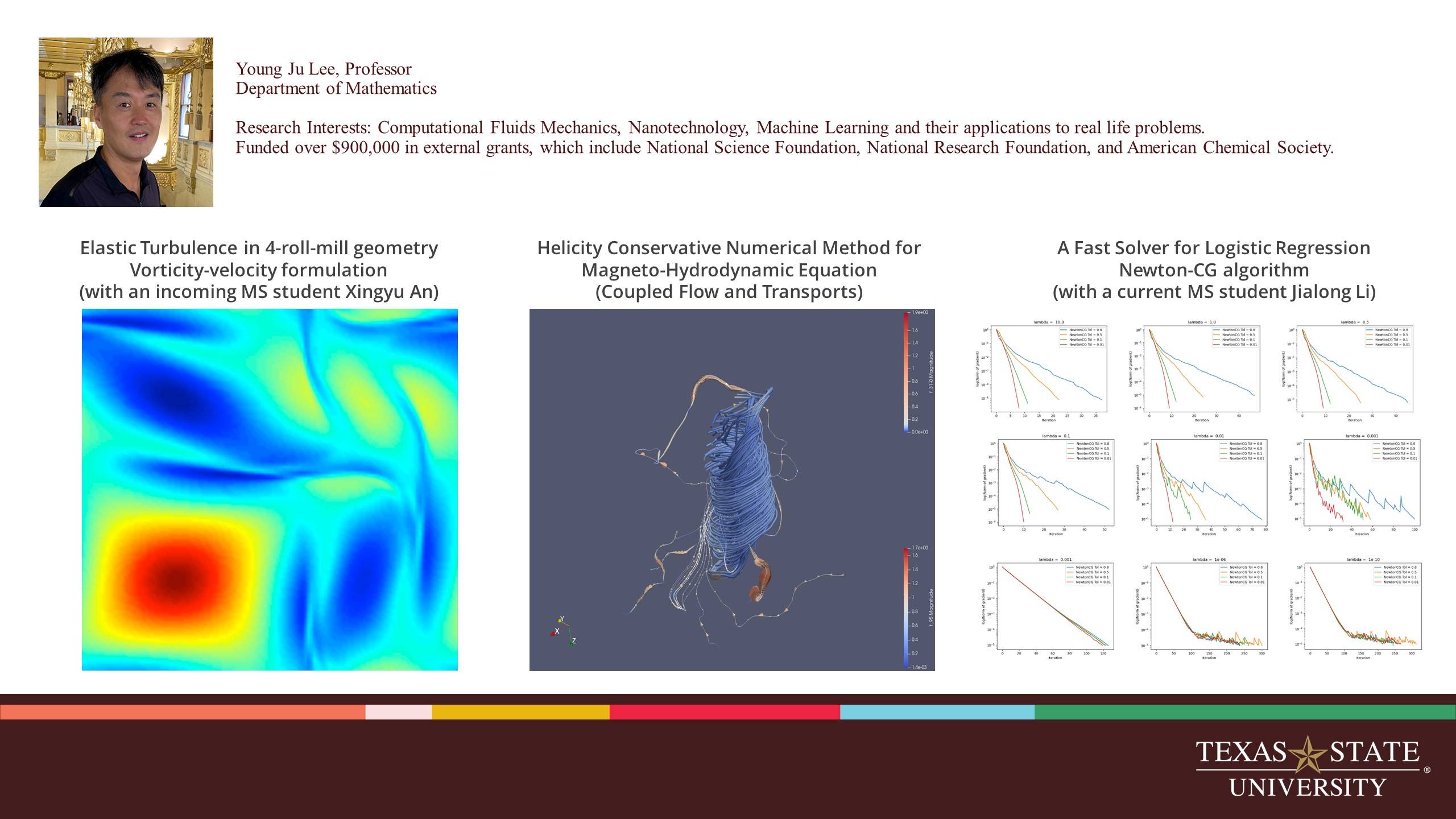
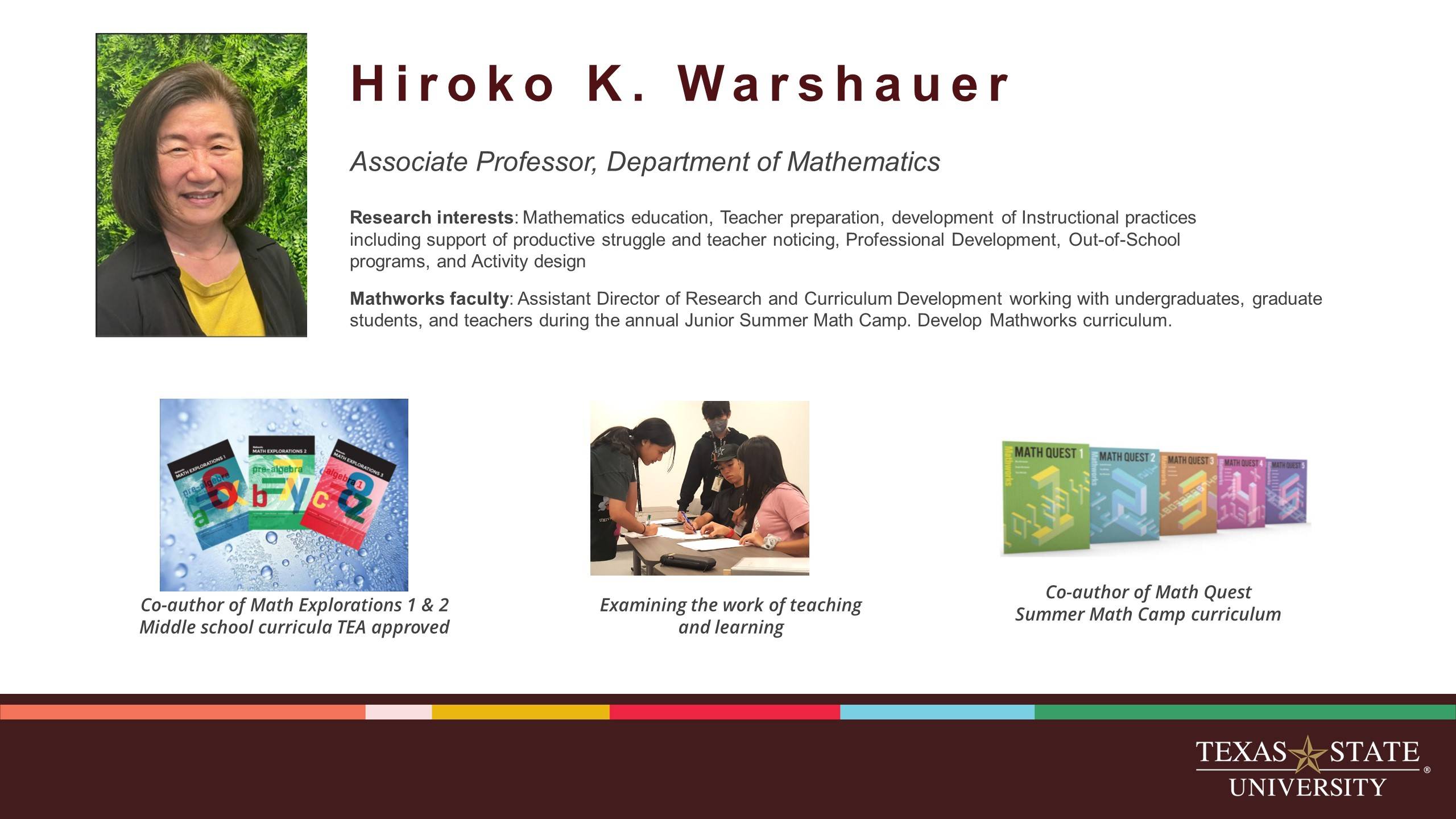
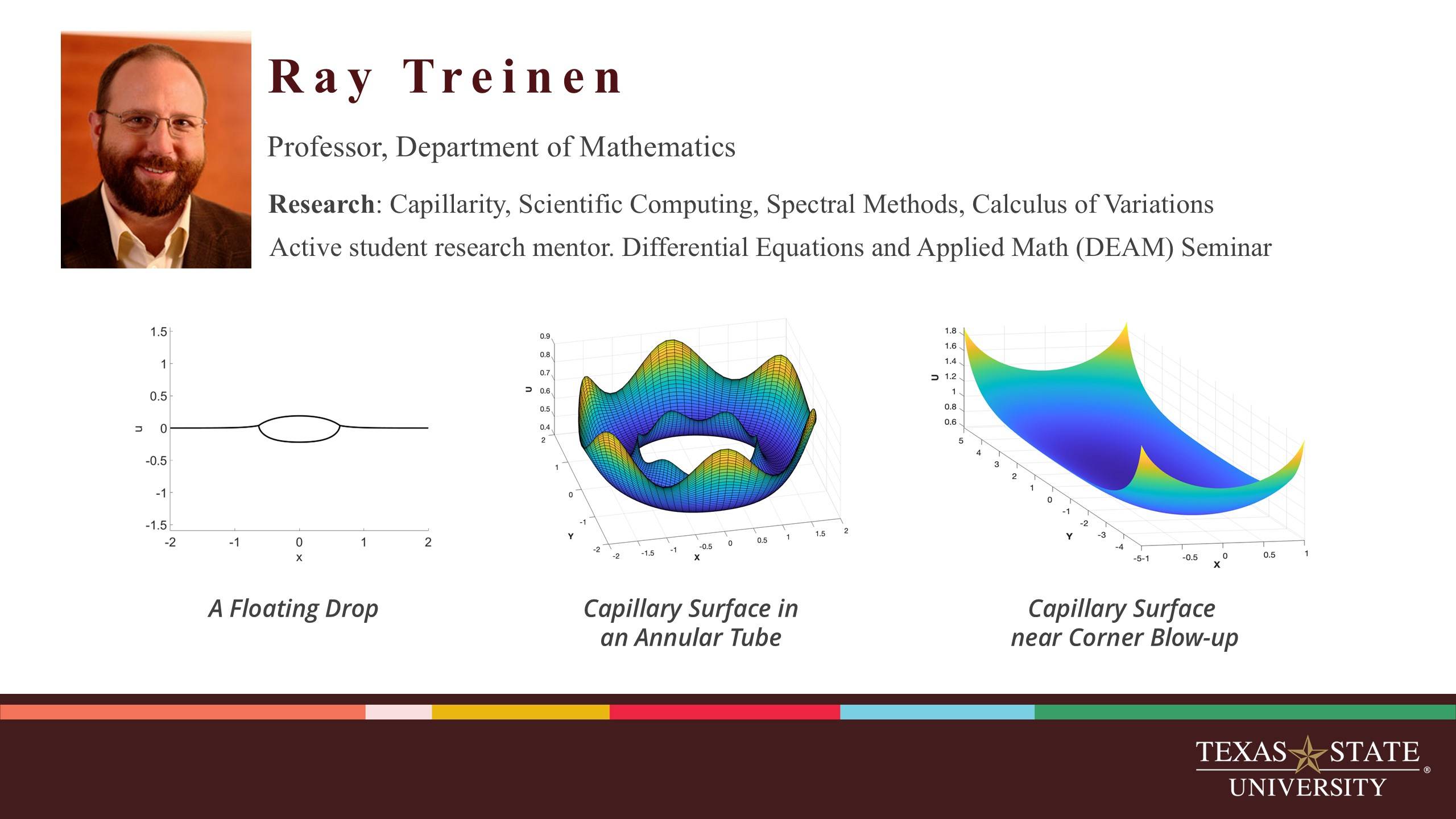
Discover our dynamic faculty and the innovative research they’re driving through, high-impact grant awards.
NEXT in Math
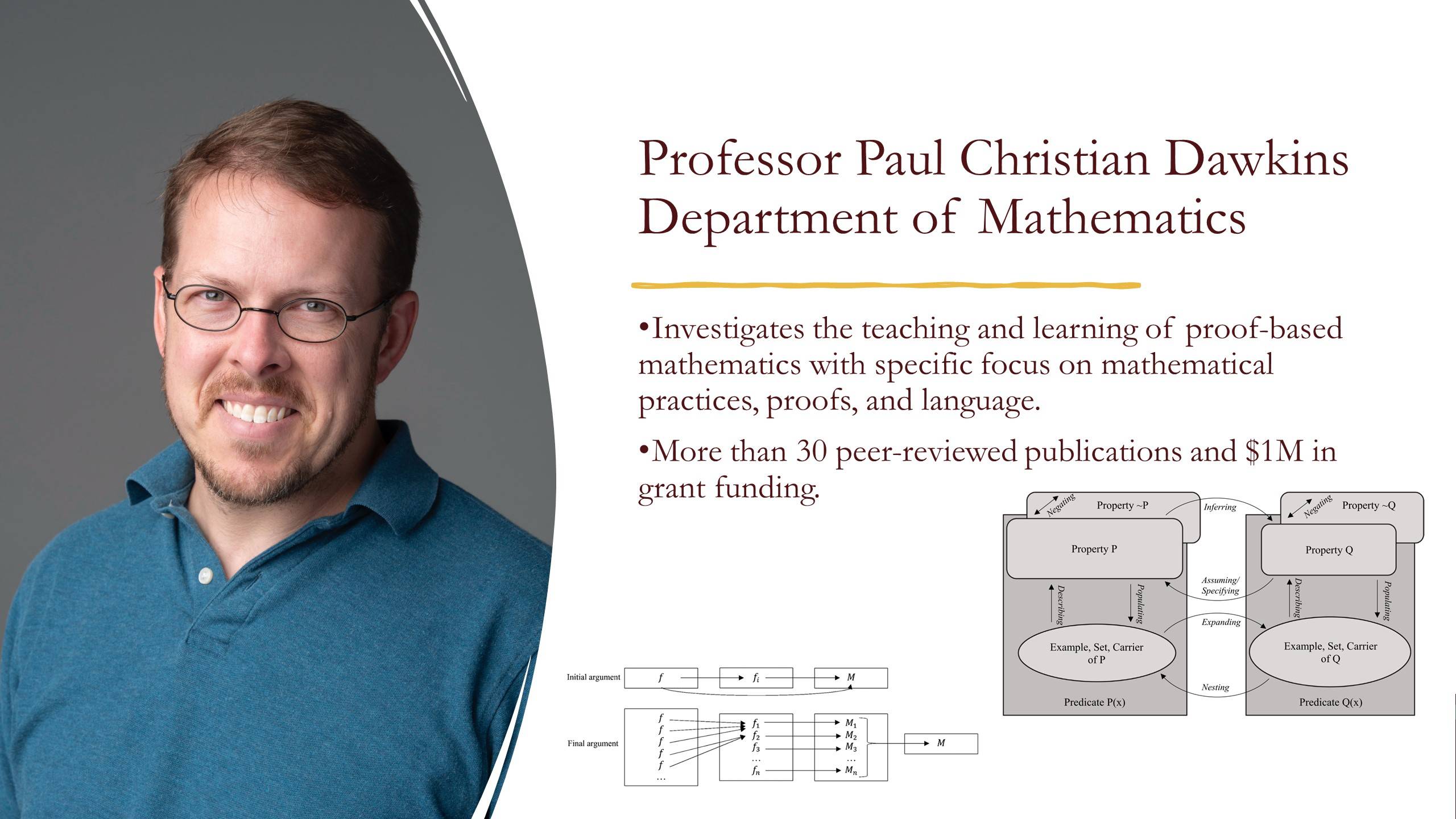
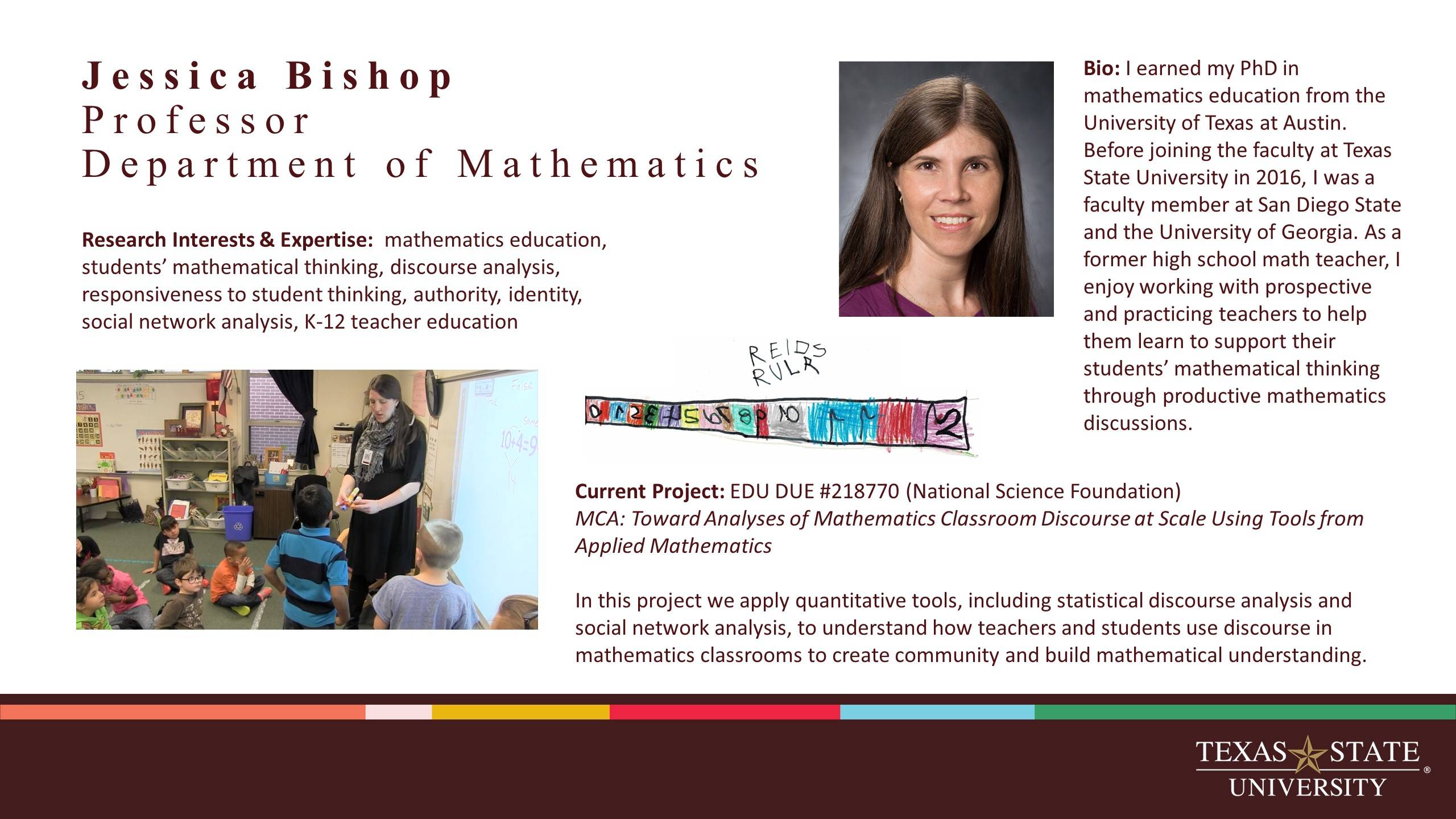
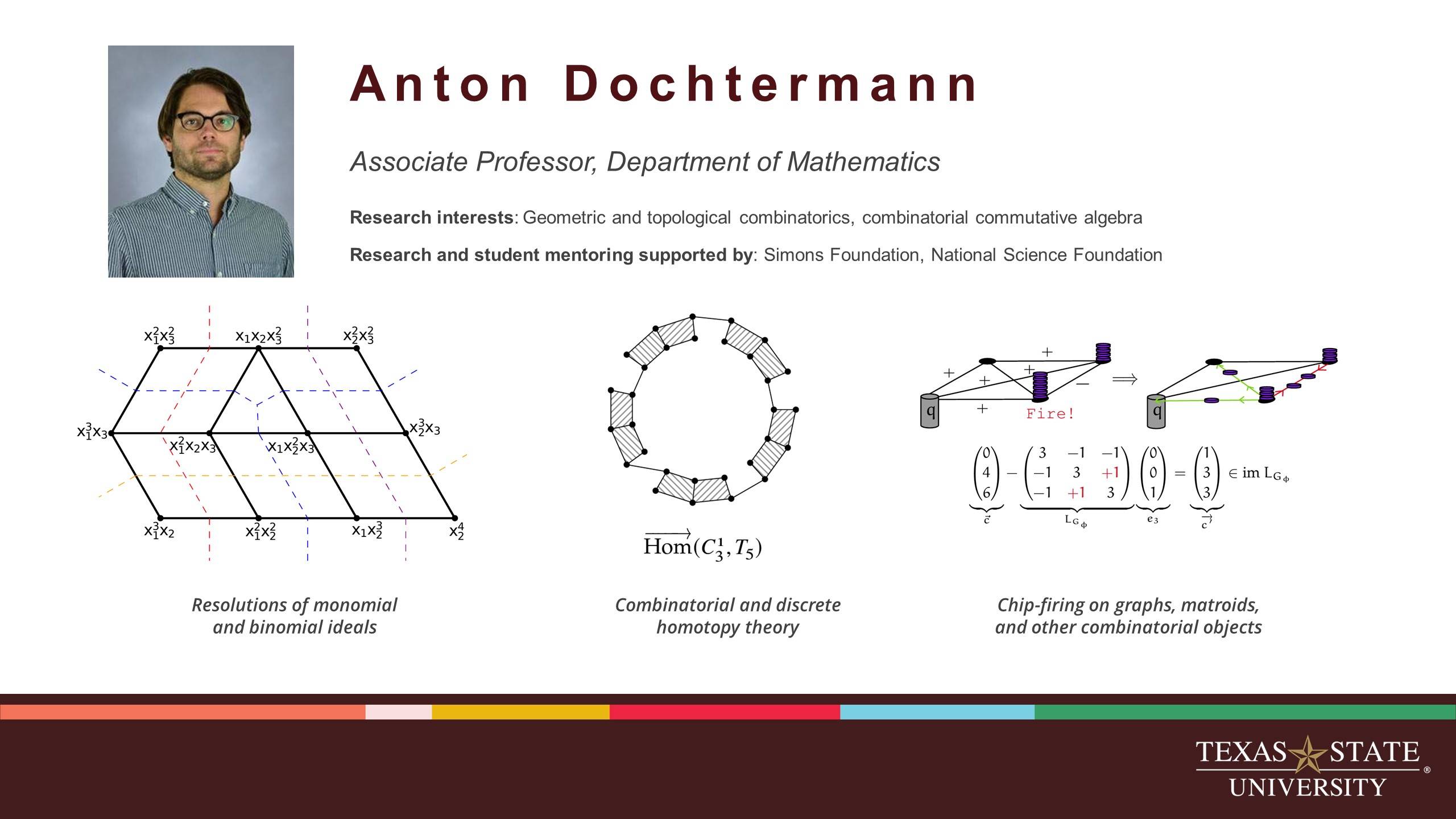
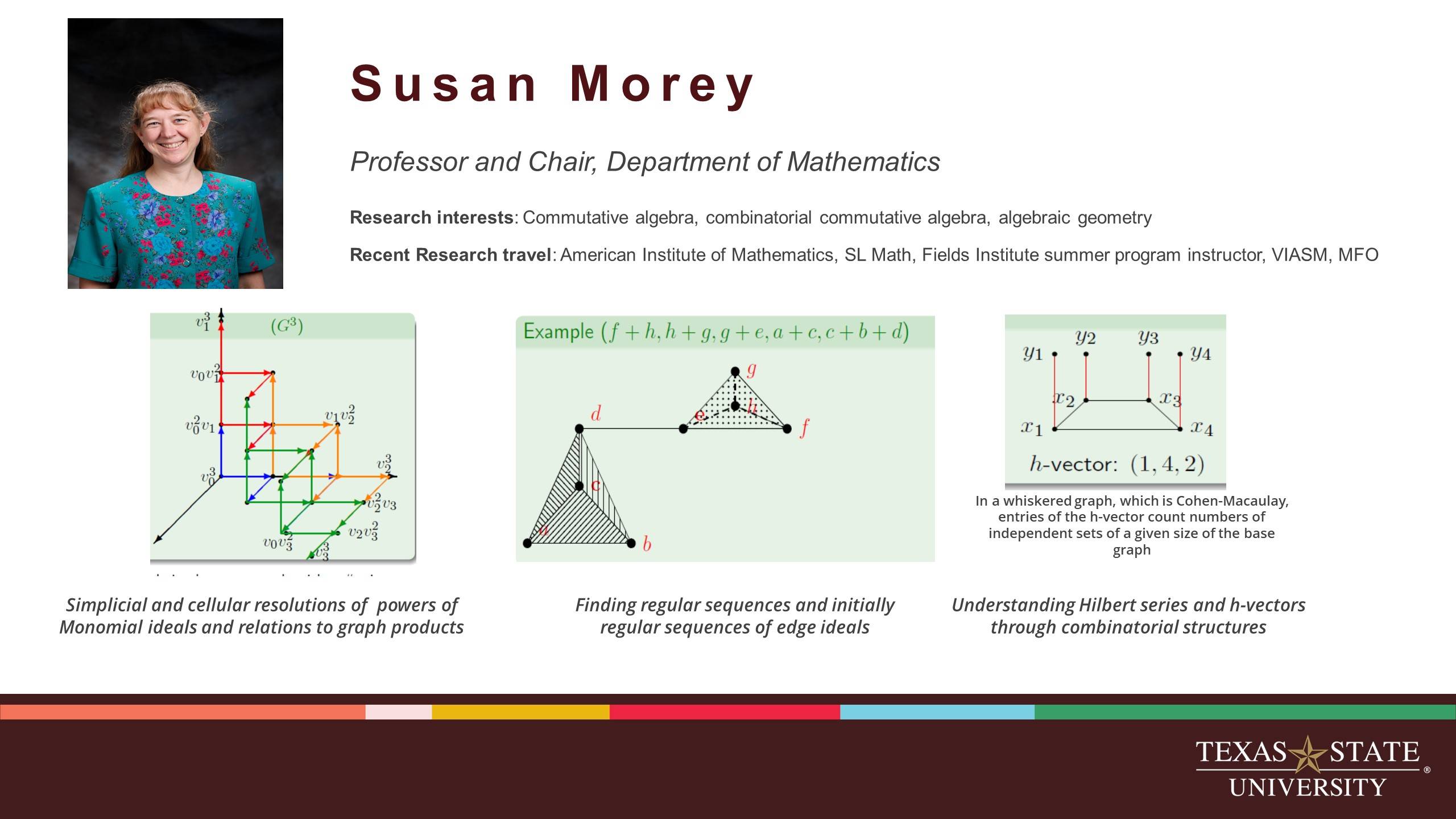
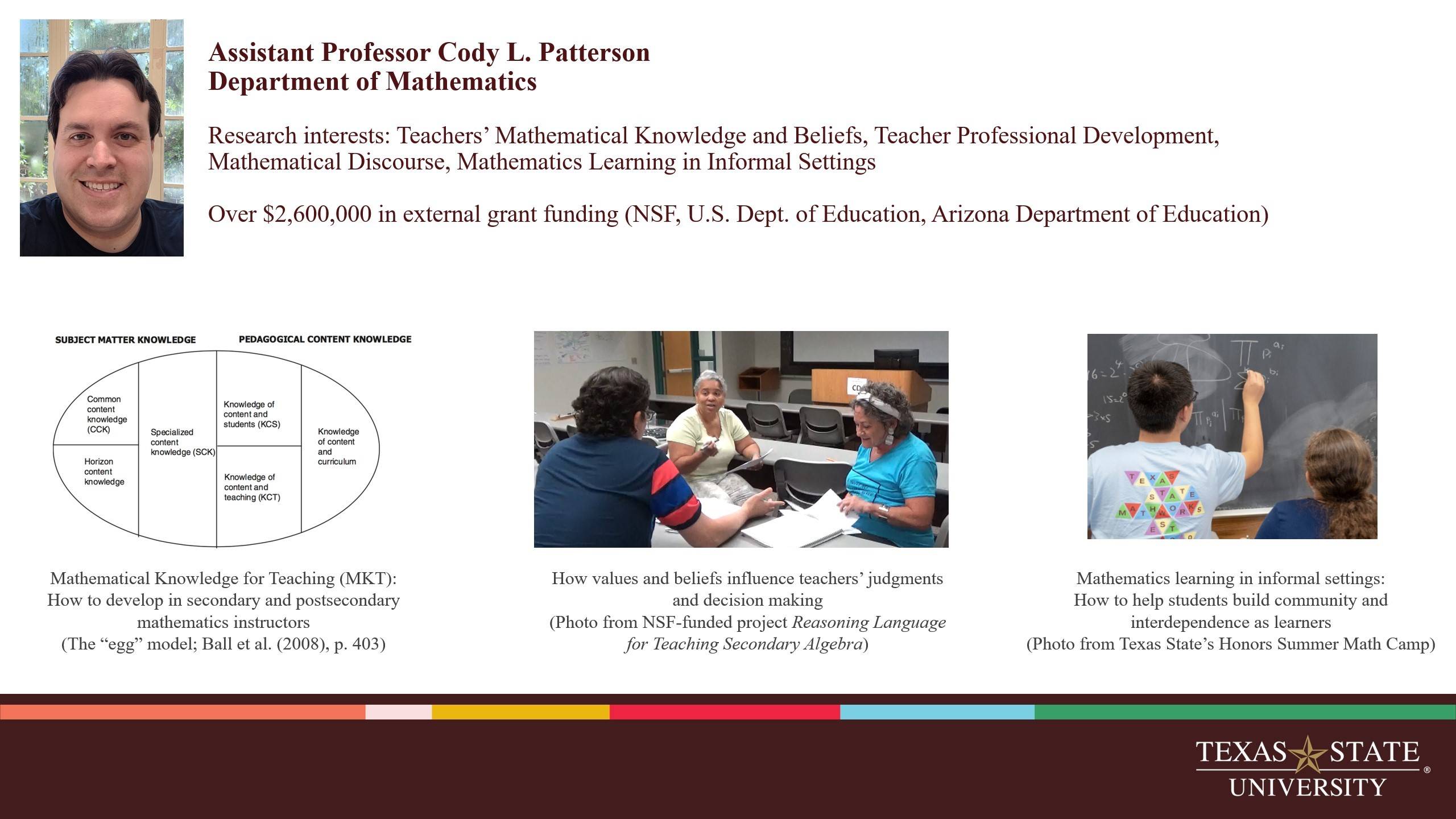
Promotion from Assistant Professor to Associate Professor & Tenure
Hiroaki Tanaka
Promotion from Associate Professor to Professor
Kathleen Melhuish and Hiroko Warshauer
@TXST Math
- Location:
- DERR 330; 330
- Cost:
- Free
- Contact:
- Jackson Rebrovich (jdr134@txstate.edu)
The Math Club is a student-led organization for anyone who enjoys problem-solving, logical thinking, and exploring math beyond the classroom. Whether you love tackling challenging puzzles, preparing for competitions, or just want to sharpen your skills with friends, our club offers a fun and supportive environment to learn, collaborate, and grow. No matter your experience level, curiosity is all you need—come think, solve, and discover with us!
Our theme for the semester will be:
"Learn Math with AI'' Click here for more information
more about event
Our theme for the semester will be:
"Learn Math with AI'' Click here for more information
- Location:
- DERR 336; 336
- Cost:
- Free
- Contact:
- Christine Lee
vne11@txstate.edu - Campus Sponsor:
- Department of Mathematics
Arik Wilbert
University of South Alabama
Title: Knot Invariants, Categorification, and Representation Theory
Abstract: This talk surveys some connections between topology, geometry, and representation theory. I will begin by discussing how representations of (quantum) sl2 can be used to construct the famous Jones polynomial and extend this invariant from links to tangles. Then, I will introduce certain algebraic varieties called Springer fibers, and explain how they can be used to geometrically construct and classify irreducible representations of the symmetric group. These two topics turn out to be closely related. In fact, one the one hand, one can study the topology of certain Springer fibers using the combinatorics of sl2. On the other hand, Springer fibers can be used to categorify the Jones polynomial. Time permitting, I will discuss how this picture might generalize if we replace the classical Springer fibers by so-called Delta Springer varieties introduced by Griffin-Levinson-Woo in 2021. Click here for more information
more about event
University of South Alabama
Title: Knot Invariants, Categorification, and Representation Theory
Abstract: This talk surveys some connections between topology, geometry, and representation theory. I will begin by discussing how representations of (quantum) sl2 can be used to construct the famous Jones polynomial and extend this invariant from links to tangles. Then, I will introduce certain algebraic varieties called Springer fibers, and explain how they can be used to geometrically construct and classify irreducible representations of the symmetric group. These two topics turn out to be closely related. In fact, one the one hand, one can study the topology of certain Springer fibers using the combinatorics of sl2. On the other hand, Springer fibers can be used to categorify the Jones polynomial. Time permitting, I will discuss how this picture might generalize if we replace the classical Springer fibers by so-called Delta Springer varieties introduced by Griffin-Levinson-Woo in 2021. Click here for more information
- Location:
- DERR 121; 121
- Cost:
- Free
- Contact:
- Cameron Farnsworth
cfarnsworth@txstate.edu - Campus Sponsor:
- Department of Mathematics
Love a good problem? Like to solve difficult puzzles?
Join professors, graduate students and undergraduates as we tackle problems presented from several mathematical journals. An interest in higher level mathematics is all that is required to join our round table. Offer what you know, learn what you don't in a relaxed environment with some of our department's finest! Click here for more information
more about event
Join professors, graduate students and undergraduates as we tackle problems presented from several mathematical journals. An interest in higher level mathematics is all that is required to join our round table. Offer what you know, learn what you don't in a relaxed environment with some of our department's finest! Click here for more information
- Location:
- DERR 325; 325
- Cost:
- Free
- Contact:
- Young Ju Lee
yjlee@txstate.edu - Campus Sponsor:
- Department of Mathematics
Dr. Jonathan Siegel
Texas A&M
Title: Constructing Symmetry-Preserving Neural Network Models
Abstract: In many practical applications of machine learning, especially to scientific disciplines like physics, chemistry, or biology, the ground truth satisfies some known symmetries. For example, the chemical properties of a molecule are invariant to rotations, translations, and permutation of identical atoms. In such applications, it is often highly desirable to build these symmetries into the neural network model. We will discuss two methods for doing this: constructing special architectures which preserve the desired symmetries, and building invariance into a standard (non-invariant) architecure via pre- and postprocessing the inputs and outputs. For the former, we will discuss universality and approximation rates for the popular permutation invariant Deep Sets architecture. For the latter, we will discuss the construction of canonicalizations and weighted frames for the actions of permutations and rotations. Click here for more information
more about event
Texas A&M
Title: Constructing Symmetry-Preserving Neural Network Models
Abstract: In many practical applications of machine learning, especially to scientific disciplines like physics, chemistry, or biology, the ground truth satisfies some known symmetries. For example, the chemical properties of a molecule are invariant to rotations, translations, and permutation of identical atoms. In such applications, it is often highly desirable to build these symmetries into the neural network model. We will discuss two methods for doing this: constructing special architectures which preserve the desired symmetries, and building invariance into a standard (non-invariant) architecure via pre- and postprocessing the inputs and outputs. For the former, we will discuss universality and approximation rates for the popular permutation invariant Deep Sets architecture. For the latter, we will discuss the construction of canonicalizations and weighted frames for the actions of permutations and rotations. Click here for more information
- Location:
- Online Only
- Cost:
- Free
- Contact:
- Vera Ioudina
vi11@txstate.edu - Campus Sponsor:
- Department of Mathematics
Novel Ensemble Feature Selection Approach and Application in Repertoire Sequencing Data
Tao He - San Francisco State University
Abstract: The adaptive immune system, shaped by somatic V(D)J recombination, may offer prognostic or predictive biomarkers through VJ gene usage. However, analyzing the immune repertoire is challenging due to clonotype heterogeneity. To address this, we propose a novel ensemble feature selection approach and customized statistical learning algorithm focused on VJ gene usage. Applied to TCR sequences from recovered COVID-19 patients, healthy donors, and lung cancer patients receiving immunotherapy, our method identified distinct VJ gene usage patterns linked to recovery and clinical response. Simulation studies show our approach outperforms existing feature selection methods in efficiency, accuracy, stability, and sensitivity, with lower false discovery rates. Our method effectively classifies immune subtypes, providing insights into immune response signatures to improve treatment strategies.
Bio: Dr. Tao He is an Associate Professor in the Department of Mathematics at San Francisco State University. Her research focuses on developing novel statistical methodologies and computational tools for analyzing large-scale biomedical data, including applications in genome-wide association studies, repertoire sequencing data analysis, and floor vibration data, where she develops methods to use structural vibration signals to predict gait. She has received federal research funding from the National Science Foundation (NSF) and the National Institutes of Health (NIH). In addition, she has been awarded several internal research grants from San Francisco State University. She currently serves as President-Elect of the San Francisco Bay Area chapter of the American Statistical Association. Dr. He holds a dual doctoral degree in Statistics and Quantitative Biology from Michigan State University.
Here is the Zoom link for those who cannot attend in person:
https://txstate.zoom.us/j/84190833370?pwd=OzF6cbIZGLqT2fBnUGN8qQwCHSidVf.1
Meeting ID: 84190833370 Passcode: SS_Derr333 Click here for more information
more about event
Tao He - San Francisco State University
Abstract: The adaptive immune system, shaped by somatic V(D)J recombination, may offer prognostic or predictive biomarkers through VJ gene usage. However, analyzing the immune repertoire is challenging due to clonotype heterogeneity. To address this, we propose a novel ensemble feature selection approach and customized statistical learning algorithm focused on VJ gene usage. Applied to TCR sequences from recovered COVID-19 patients, healthy donors, and lung cancer patients receiving immunotherapy, our method identified distinct VJ gene usage patterns linked to recovery and clinical response. Simulation studies show our approach outperforms existing feature selection methods in efficiency, accuracy, stability, and sensitivity, with lower false discovery rates. Our method effectively classifies immune subtypes, providing insights into immune response signatures to improve treatment strategies.
Bio: Dr. Tao He is an Associate Professor in the Department of Mathematics at San Francisco State University. Her research focuses on developing novel statistical methodologies and computational tools for analyzing large-scale biomedical data, including applications in genome-wide association studies, repertoire sequencing data analysis, and floor vibration data, where she develops methods to use structural vibration signals to predict gait. She has received federal research funding from the National Science Foundation (NSF) and the National Institutes of Health (NIH). In addition, she has been awarded several internal research grants from San Francisco State University. She currently serves as President-Elect of the San Francisco Bay Area chapter of the American Statistical Association. Dr. He holds a dual doctoral degree in Statistics and Quantitative Biology from Michigan State University.
Here is the Zoom link for those who cannot attend in person:
https://txstate.zoom.us/j/84190833370?pwd=OzF6cbIZGLqT2fBnUGN8qQwCHSidVf.1
Meeting ID: 84190833370 Passcode: SS_Derr333 Click here for more information
- Location:
- ALKEK 250; 250
- Cost:
- Free
- Contact:
- Katie McKee
fyy28@txstate.edu - Campus Sponsor:
- Department of Mathematics
Join us for a celebration of excellence!
The Mathematics Department invites you to our Student Awards Ceremony
Celebrate our outstanding students and Mathematics & Statistics Awareness Month with us!
Let’s honor achievement, innovation, and the power of mathematics together.
The Mathematics Department invites you to our Student Awards Ceremony
Celebrate our outstanding students and Mathematics & Statistics Awareness Month with us!
Let’s honor achievement, innovation, and the power of mathematics together.
- Location:
- DERR 238; 238
- Cost:
- Free
- Contact:
- Illona Weber ih10@txstate.edu
- Campus Sponsor:
- Department of Mathematics
Math CATS is here to assist in most MATH courses! If you're intimidated by the subject, come in and let's problem solve together. Tutors are here to help reiterate, reinforce and help you relate to the content you heard in lecture. FREE & NO APPOINTMENT NEEDED!
Click here for more information
more about event