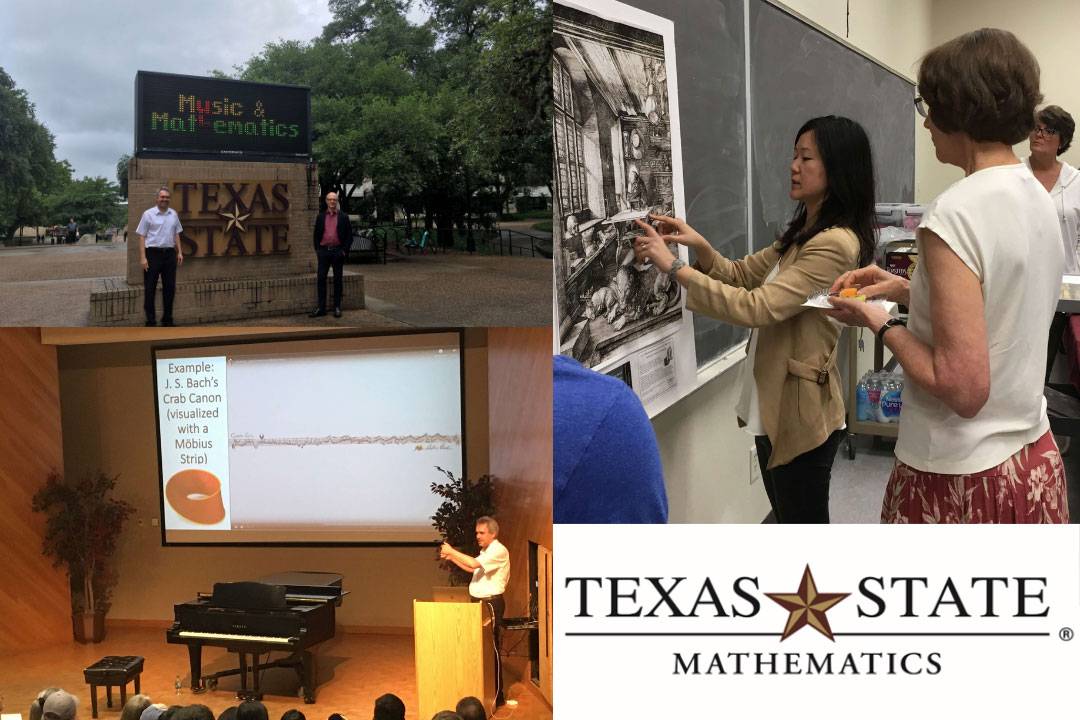
Seminars and events this week in math.

Location:
DERR 336; 336
Cost:
Free
Contact:
Christine Lee
vne11@txstate.edu
Campus Sponsor:
Department of Mathematics
Tye Lidman from North Carolina State University
Title: Knots and their complements
Abstract: One way to study a knot in three-dimensional space is by looking at the topology of the complement. For knots in the three-sphere, Gordon and Luecke proved that the topology of the knot complement completely determines the knot. We will discuss generalizations of this idea to some other settings.
Click here for more information
more about event

Location:
DERR 338; 338
Cost:
Free
Contact:
Hamilton Hardison
hhardison@txstate.edu
Campus Sponsor:
Department of Mathematics
Faculty and students learn about and discuss issues related to the teaching and learning of mathematics and new findings in mathematics education research. Graduate students in the Mathematics Education programs are expected to attend whenever possible; students from other programs are always welcome. Click here for more information
more about event

Location:
DERR 121; 121
Cost:
Free
Contact:
Cameron Farnsworth
cfarnsworth@txstate.edu
Campus Sponsor:
Department of Mathematics
Love a good problem?  Like to solve difficult puzzles?
Join professors, graduate students and undergraduates as we tackle problems presented from several mathematical journals.  An interest in higher level mathematics is all that is required to join our round table.  Offer what you know, learn what you don't in a relaxed environment with some of our department's finest!
Click here for more information
more about event

Location:
DERR 333; 333
Cost:
Free
Contact:
Vera Ioudina
vi11@txstate.edu
Campus Sponsor:
Department of Mathematics
Battle of the Bands: Using R Shiny to Disentangle Contributions in Indie Rock Collaborations

William Cipolli
Colgate University

Abstract: The Data Science Collaboratory at Colgate University addresses the gap in statistical research support common at smaller institutions. To empower instructors, students, and the broader research community, we developed R Shiny web applications that facilitate technically sound analyses paired with foundational learning materials and case studies. We will discuss one such case study where we analyze the music and lyrics of three collaborating indie rock bands to understand their individual contributions, including data collection, ethical considerations, and results that align with publicly available information.

Bio: Dr. Cipolli is an Associate Professor of Mathematics at Colgate University. He specializes in Bayesian nonparametric statistics and develops flexible approaches to modern statistical problems. As the cofounder of Colgate's Data Science Collaboratory, Will collaborates on diverse projects across Biology, Psychology, and Sociology, and he is a lead developer of R Shiny applications for both statistical analysis and education.

Here is the Zoom link for those who cannot attend in person:
https://txstate.zoom.us/j/84190833370?pwd=OzF6cbIZGLqT2fBnUGN8qQwCHSidVf.1
Meeting ID:  84190833370       Passcode: SS_Derr333
Click here for more information
more about event

Location:
DERR 336; 336
Cost:
Free
Contact:
Christine RS Lee
vne11@txstate.edu
Campus Sponsor:
Department of Mathematics
Rene Cabrera from the University of Texas at Austin

Title. GAN: Dynamics and Mode Collapse

Abstract. Generative Adversarial Networks (GANs) were among the first machine learning algorithms capable of producing remarkably realistic synthetic data. In this talk, we focus on a simplified, toy setting that exposes the core mechanics of the GAN algorithm and its connection to optimal transport theory. We show how, in shallow architectures, GAN training can be interpreted as an approximation of an underlying system of partial differential equations. Within this reduced framework, we analyze a concrete toy example that exhibits pathological behavior analogous to mode collapse. This example illustrates how the PDE viewpoint clarifies the dynamical mechanisms responsible for non-convergence and instability in GAN training.
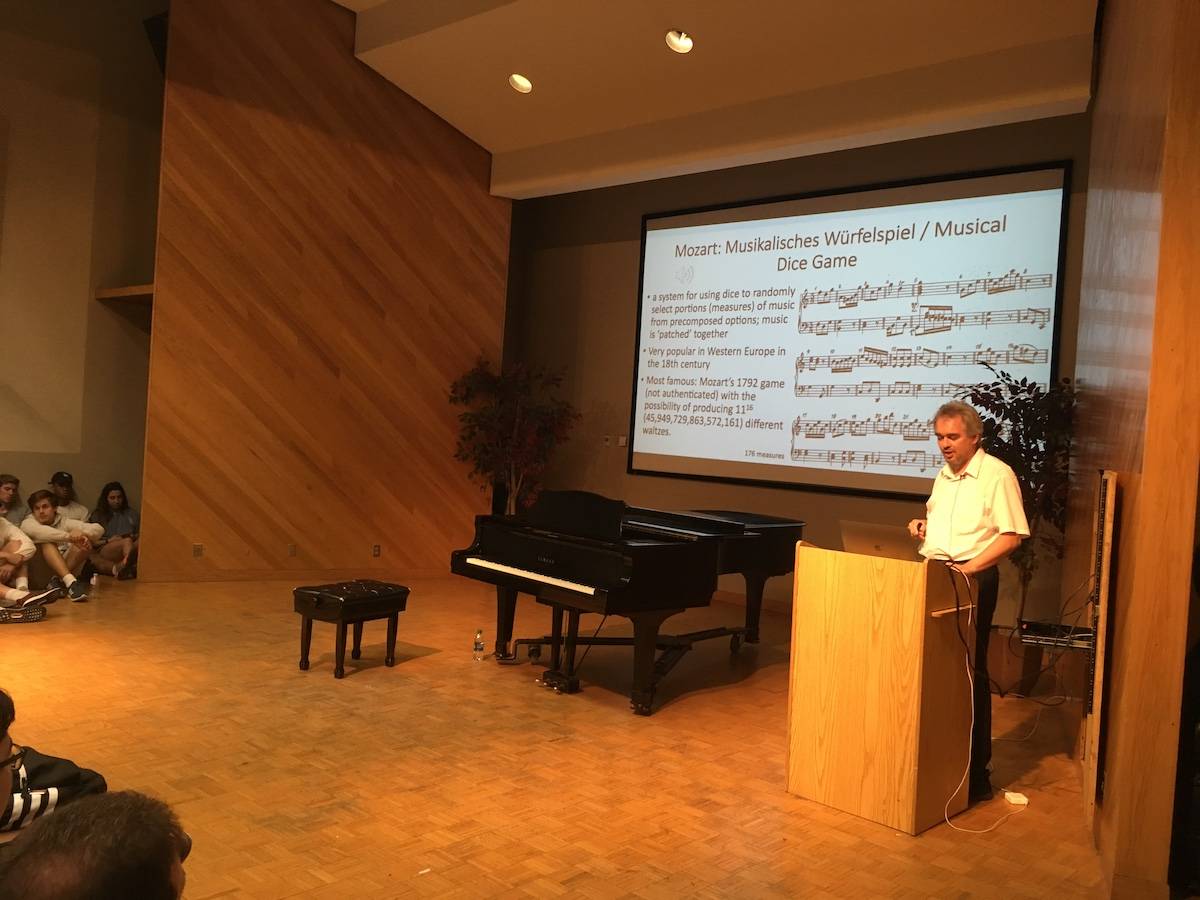
Professor speaking at a colloquium

Colloquium

The math department hosts a colloquium series in which distinguished researchers present their recent work to a general mathematical audience.  All faculty, graduate students and undergraduate students are welcome.

View a short video about our Colloquium series

Organizer: Jeremiah Birrell

Algebraic Combinatorics Reading Seminar

This seminar meets about once a week.  The format is very informal, the idea is that we collectively select a topic for the semester and present material surround that theme.  Original research is not typically presented and we encourage participation from all levels. Graduate students with an interest in algebra/combinatorics are especially encouraged to attend. 

For more information or to be included in communication regarding this seminar please contact Anton Dochtermann.

reading seminar logo
professor leading a seminar

Differential Equations and Applied Math Seminar (DEAM)

The Differential Equations and Applied Math Seminar is a seminar for those interested in differential equations, mathematical modeling, mathematical physics, scientific computation, and any other interdisciplinary mathematical work of an applied nature.  The speaker's topics are not restricted to their own work, as this seminar is a platform for presenting details of mathematics of interest.  Interested faculty, graduate students, and advanced undergraduates are encouraged to attend.

Organizers: Ray Treinen & Nestor Guillen

Discrete Math Seminar

All faculty, graduate students, and upper level undergraduate students are welcome. The seminar will provide a platform for faculty and students to present their research developments in discrete mathematics and related areas, foster research interactions among faculty and students, and create research opportunities and collaborations for faculty and students. Speakers from Discrete Mathematics, Combinatorics, Computer Science, and other related areas are all welcome. We are particularly interested in interdisciplinary research which applies mathematics as a tool to solve problems in other areas such as CS, BioInformatics, Bio‐sciences, Engineering, Physics, Chemistry, etc.

Organizer: Jian Shen

discrete math
Logic@TXST logo

Logic@TXST

This is a program designed to encourage research into mathematical logic at Texas State University and both the undergraduate and faculty levels, first by bringing in logic speakers to stimulate interest, and then fund subsequent research.

Times and locations of these talks will vary.

Organizer: Will Boney

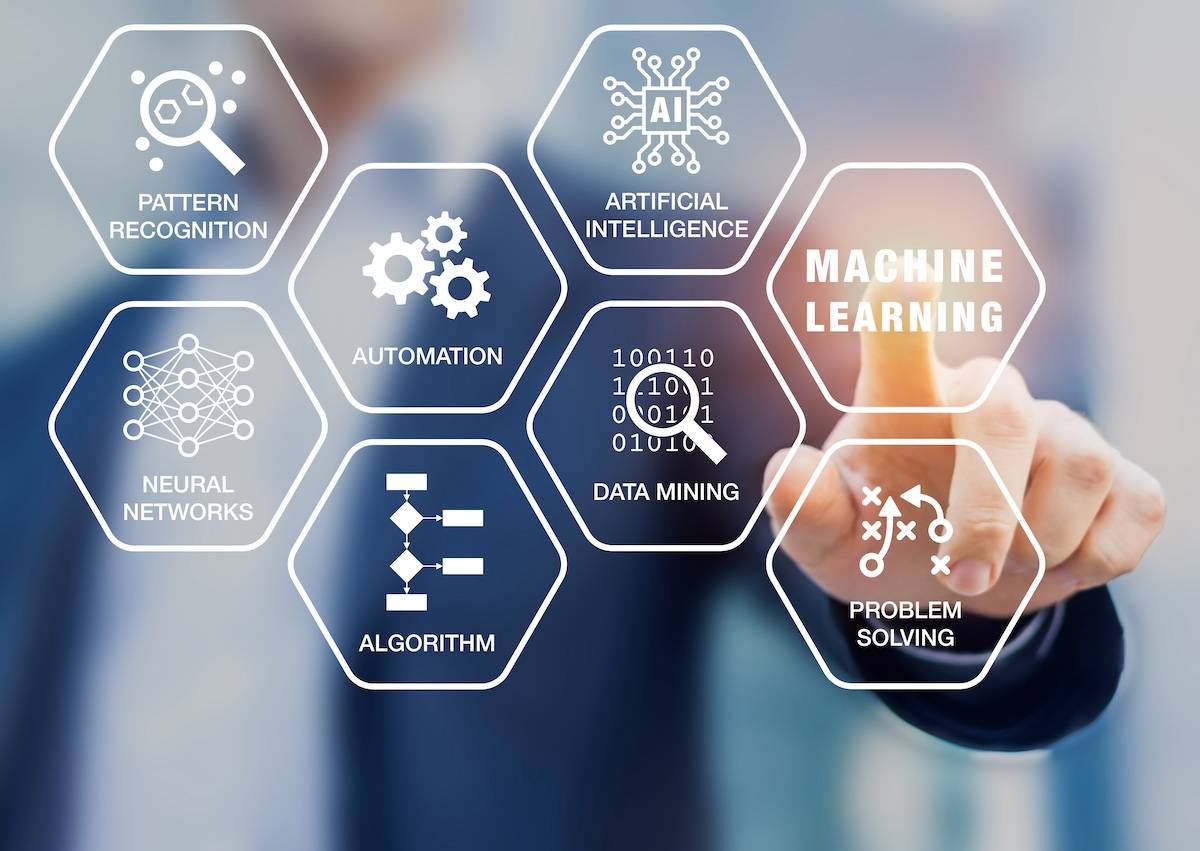
Machine Learning Reading Seminar

In this seminar we learn about the mathematical foundation of this technology and their rapidly expanding use in our world.
All interested faculty, staff, and undergraduate and graduate students are welcome.

Organizer: Christine R.S. Lee

decorative image
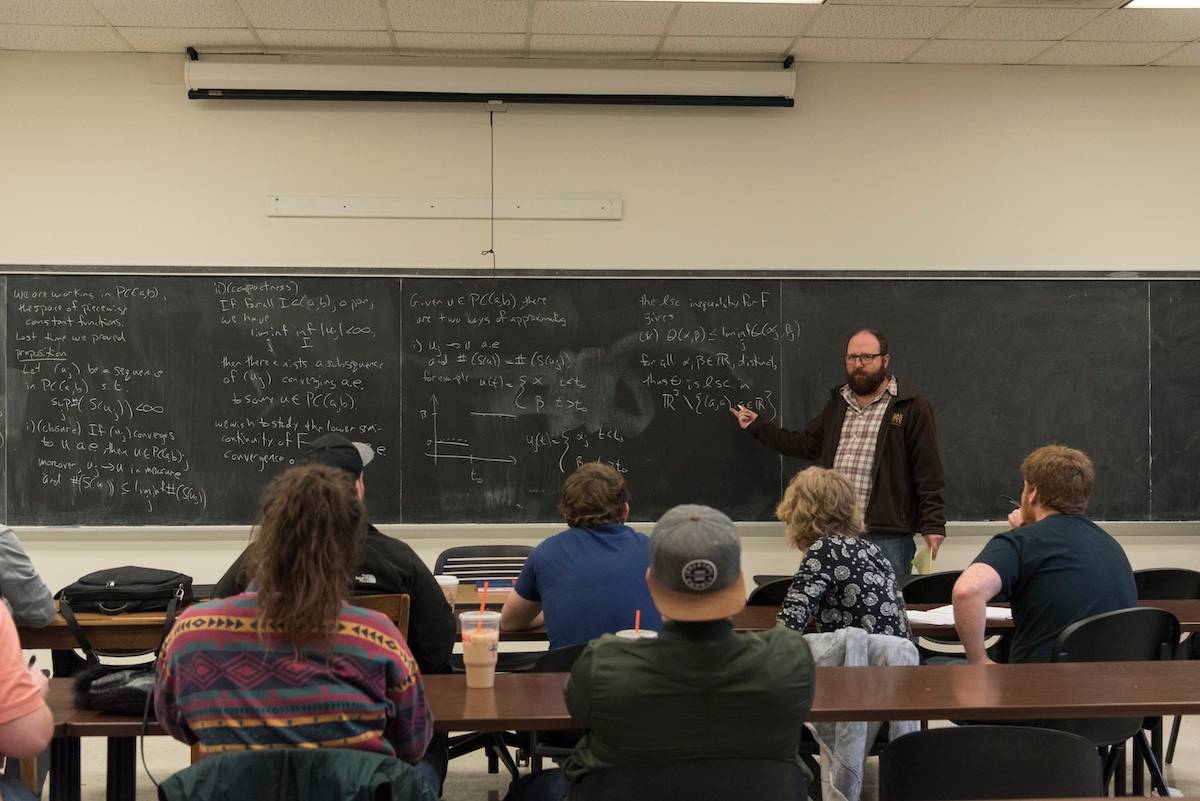
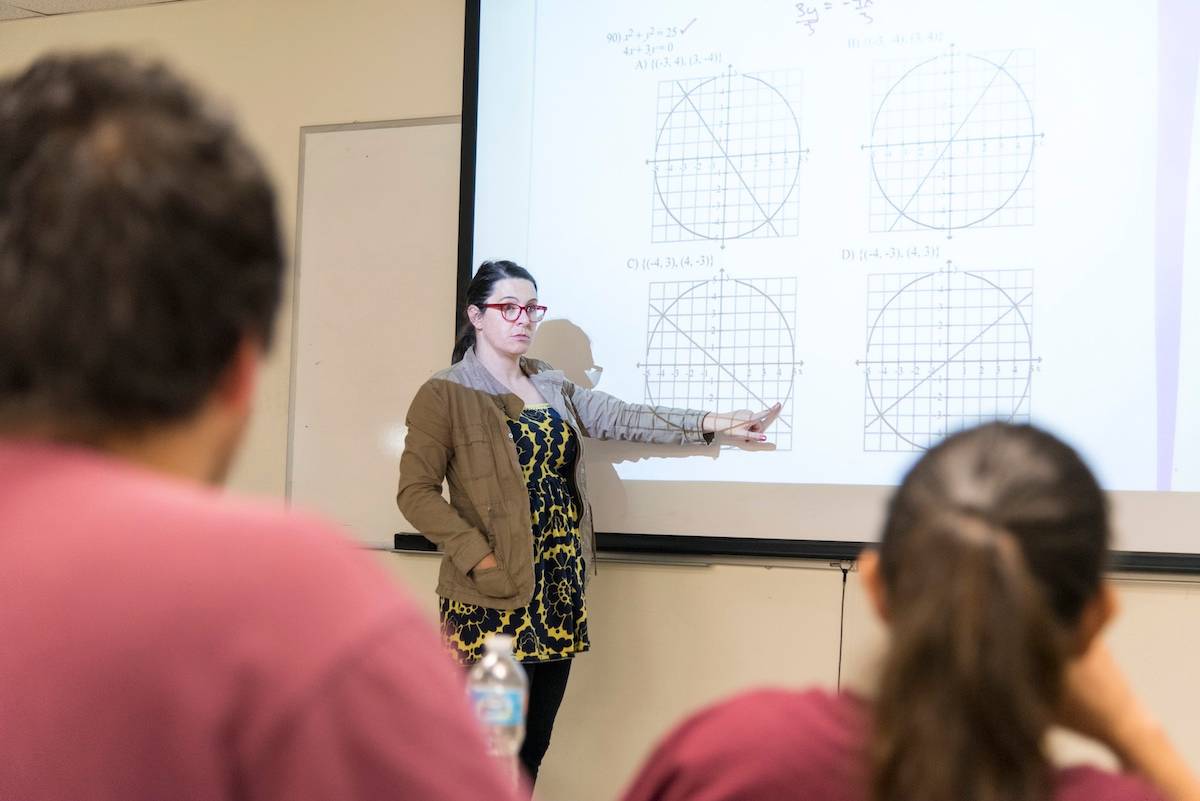
a professor teaching a class

Math Education Seminar

Faculty and students learn about and discuss issues related to the teaching and learning of mathematics and new findings in mathematics education research. Graduate students in the Mathematics Education programs are expected to attend whenever possible; students from other programs are always welcome.

Organizers:  Hamilton Hardison

Numerical Methods for Data Science and Engineering (NMDSE)

This seminar is dedicated to sharing and discussing recent discoveries in numerical methods for real-life applications, such as medical imaging, weather forecasting, and epidemiology.

Organizers: Young Ju Lee & Xiaoxi Shen

digital circuit board and tablet matrix
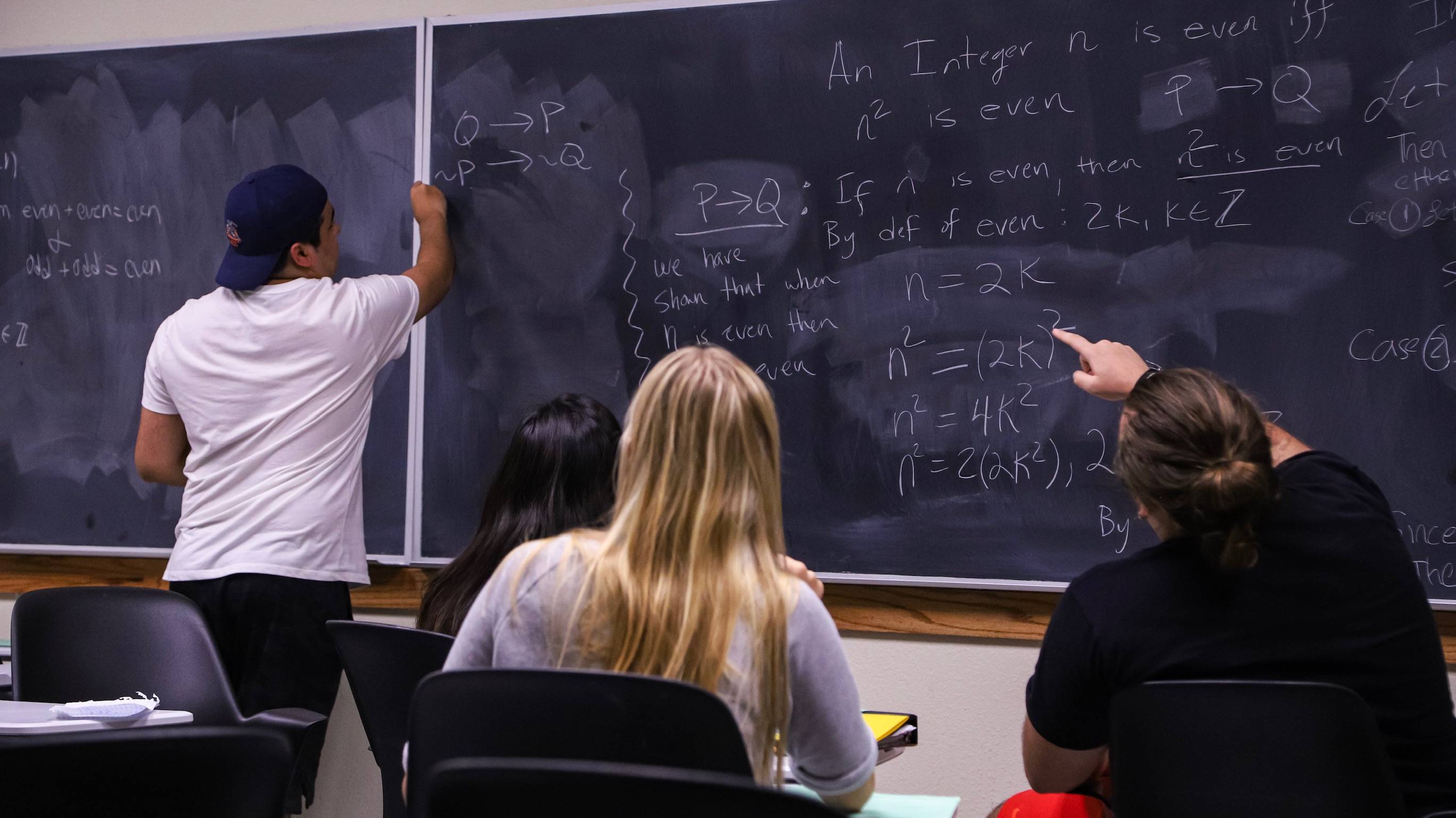
student solving problems at a blackboard

Problem Solvers Group

Love a good problem?  Like to solve difficult puzzles?
Join professors, graduate students and undergraduates as we tackle problems presented from several mathematical journals.  An interest in higher level mathematics is all that is required to join our round table.  Offer what you know, learn what you don't in a relaxed environment with some of our department's finest!

View a short video about Problem Solvers

Organizers: Cameron Farnsworth

Statistics Seminar

Interested in Statistics and Data Science?  

Join us as we discuss new developments in statistics as well as innovative lessons and advances in statistics education research.
Graduate and undergraduate students are encouraged to attend!

View a short video about our Statistics seminar.

Organizer: Vera Ioudina 

decorative image
Talk Math 2 Me logo

Talk Math 2 Me

This is a seminar for students by students. Talk Math 2 Me provides students, both graduate and undergraduate, an opportunity to present anything related to mathematics to an audience of their peers. Undergraduate and Graduate math students or any students interested in mathematics are highly encouraged to attend. The talks are each 15‐60 minutes long and possible speaking topics include Undergraduate and Graduate mathematics research, math history, and STEM research with a heavy footing in mathematics.

View a short video about Talk Math 2 Me

Organizer: Ellen Couvillion

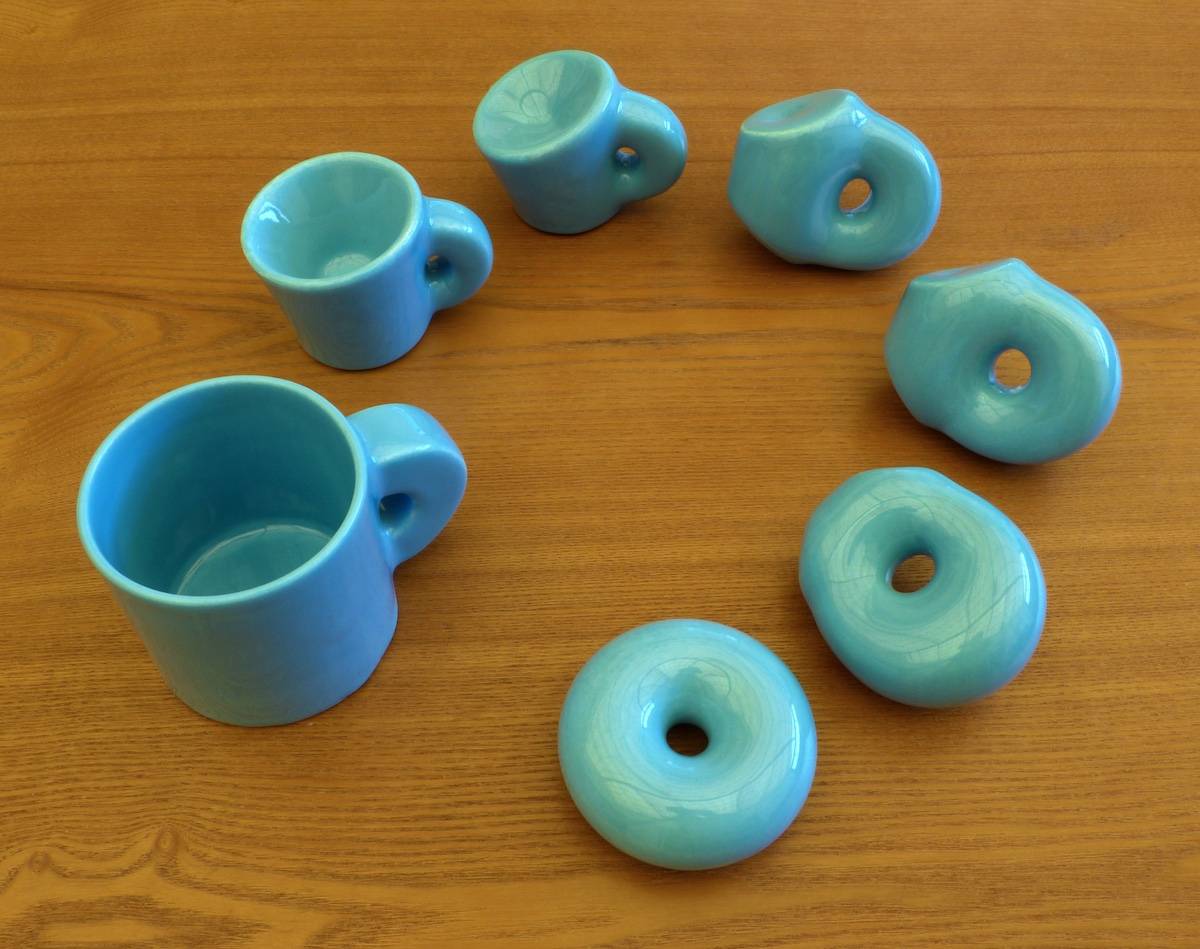
Topology Seminar

A seminar in topology: geometric, algebraic, general, abstract, combinatorial, and applied.  This is a faculty research seminar focused on topology and its applications.  Graduate and undergraduate students interested in topology and its applications are welcome to attend.

Organizer: Christine R.S. Lee

donut to coffee cup topology representaton
woman doing math

Women Doing Math

Organizer: Daniella Ferrero

Math & Stats Awareness Month

In April, the math department runs a series of annual presentations aimed at illuminating interdisciplinary connections between mathematics and other areas. We host guest speakers, partner with other departments within the university and invite panelists whose work relates to the presented themes. All presentations are geared toward the general audience. Everyone is invited.

Organizer:  Hiroko Warshauer

decorative image